The Leadership Control Trap
Why optimising and controlling your organisation is quietly limiting its ability to learn, adapt and compete.
The biggest threat to your organisation's AI future is not the technology.
It is how your leaders respond to uncertainty.
Most organisations are approaching AI as a technology initiative. Where can we automate? How do we reduce cost? How do we improve efficiency?
These are sensible questions. But they assume the world is stable.
It is not.
AI does not just optimise what exists. It expands what is possible. The organisations that succeed will not be the ones that adopt AI fastest. They will be the ones that rethink how they operate.
The real challenge is not adopting AI. It is how leaders respond to a world that is becoming much less predictable.
The Control Trap
When uncertainty increases, leaders instinctively try to regain control.
They introduce more governance. More approvals. More structure. It feels like responsible leadership. It creates a sense of order.
But in a fast-moving environment, it has unintended consequences. Decisions take longer. People wait rather than act. Curiosity is reduced. Experimentation slows. Learning declines.
Over time, something more subtle happens.
The organisation becomes less capable of adapting.
And as the environment continues to shift, the instinct is to add even more control.
This is the trap. In trying to protect the organisation, leaders quietly make it less able to respond to change.
There is an alternative.
The difference is not technology.
It is how leaders respond.
Why optimisation is no longer enough
For decades, competitive advantage came from doing known things more efficiently. Lean, Six Sigma, process re-engineering. They all share an underlying assumption: the work is knowable and repeatable.
AI breaks this assumption. It does not just make existing processes faster. It expands what is possible. It shifts the competitive terrain from "who can execute best" to "who can learn fastest."
The distinction matters. An automation lens leads to pilot projects and efficiency gains. A redesign lens leads to structural change in how decisions are made, how knowledge flows, and how the organisation learns.
Are you in the Control Trap?
Most leaders do not realise they are.
This is a quick diagnostic.
Be honest with yourself.
If you scored moderate or high:
you do not have a capability problem.
You have a leadership response problem.
And the first step is recognising it.
What this is costing you
The Control Trap is not an abstract concept. It has a direct, measurable cost. Decision delay creates idle capacity, stalled initiatives and compounding learning loss.
Use this calculator to estimate what the trap is costing your organisation right now.
The number is usually larger than leaders expect. And it only captures direct cost. The real price is the compounding effect of delayed organisational learning:
every week you are slow to adapt, the gap between you and your more adaptive competitors widens.
Return on Learning
For decades, organisations competed on scale, efficiency and execution.
Those advantages are becoming less meaningful. Technology is widely accessible. Capabilities are increasingly commoditised.
In an AI-enabled world, the advantage shifts. The only defensible advantage left is how quickly your organisation can learn and adapt.
This is what I call Return on Learning.
The mechanism that drives it is learning velocity: how quickly your organisation can detect change, interpret what it means, act on it, and evolve.
This is what determines whether you keep up, fall behind, or lead.
Learning velocity
How quickly your organisation can detect, interpret, act and evolve
The learning loop
High-performing organisations do not operate as rigid hierarchies. They operate as continuous learning systems.
At the core is a simple loop. Click each phase to understand what it means in practice.
When this loop runs effectively, intelligence compounds over time. When it does not, organisations stay busy but do not improve.
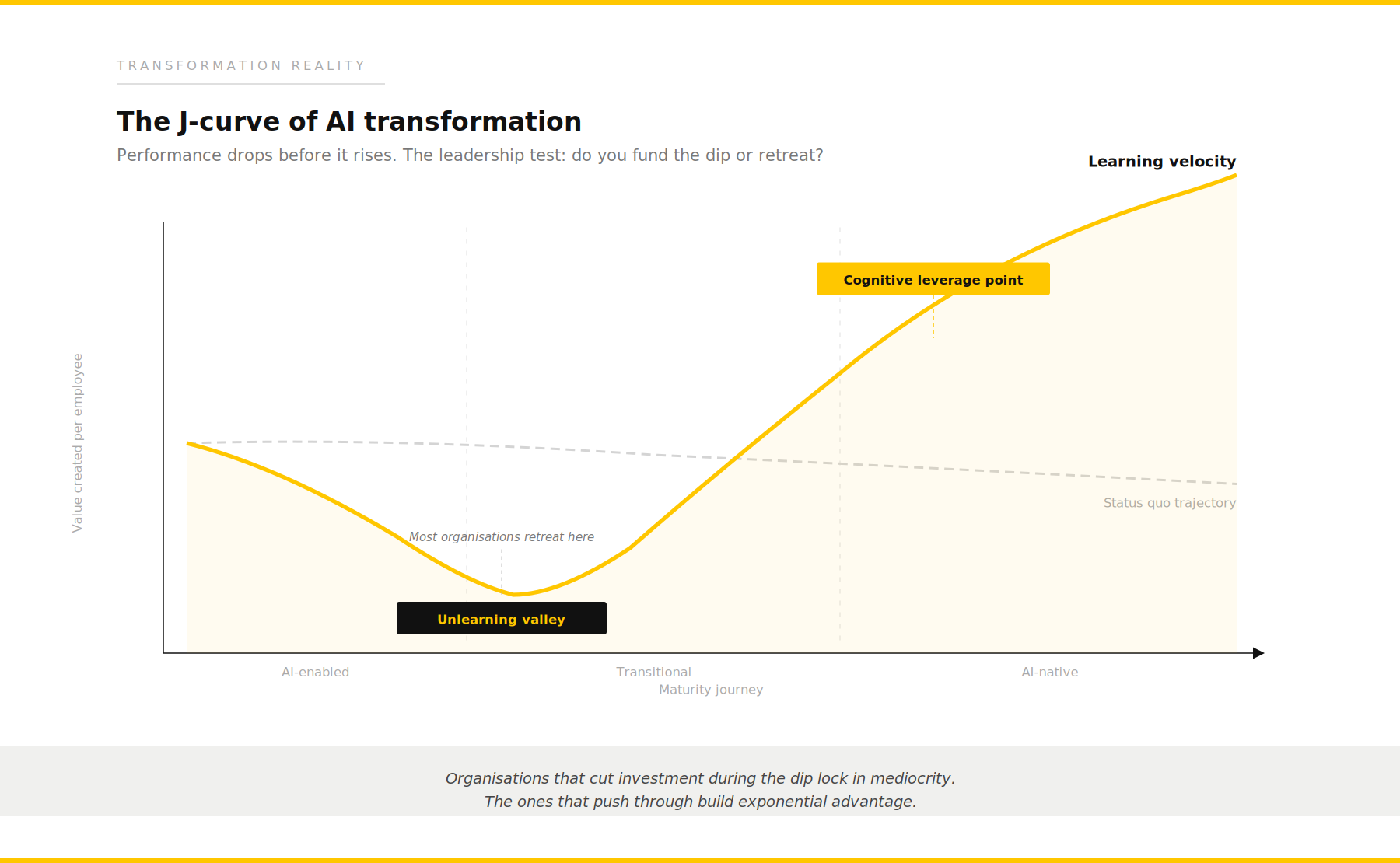
Expect the dip
There is an uncomfortable truth: it gets worse before it gets better. When organisations shift from process-centred to intelligence-centred operations, productivity dips. Teams are learning new tools while still delivering. This creates a J-curve.
The leadership test is straightforward: do you fund the dip or do you retreat?
Most organisations retreat. The ones that push through build exponential advantage, because learning velocity compounds in a way that efficiency never can.
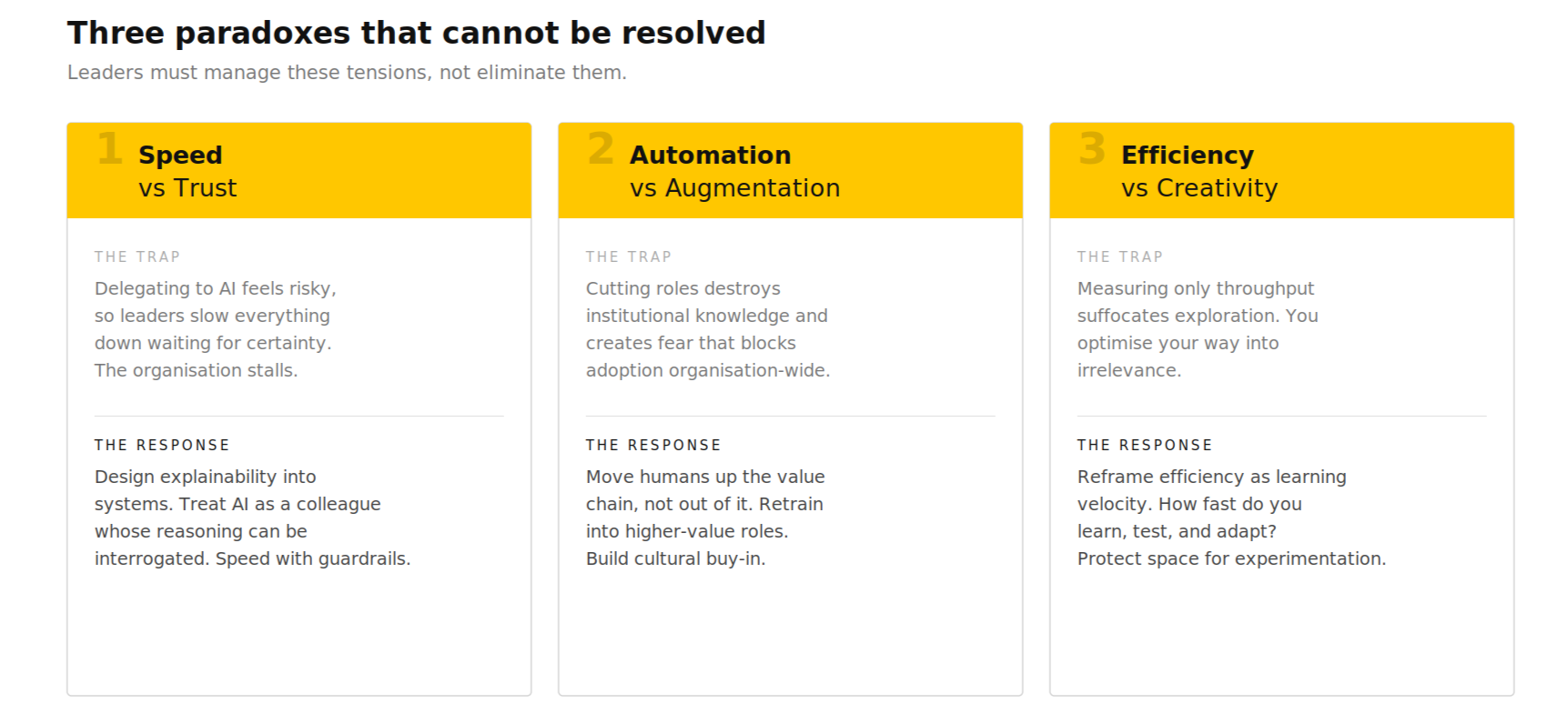
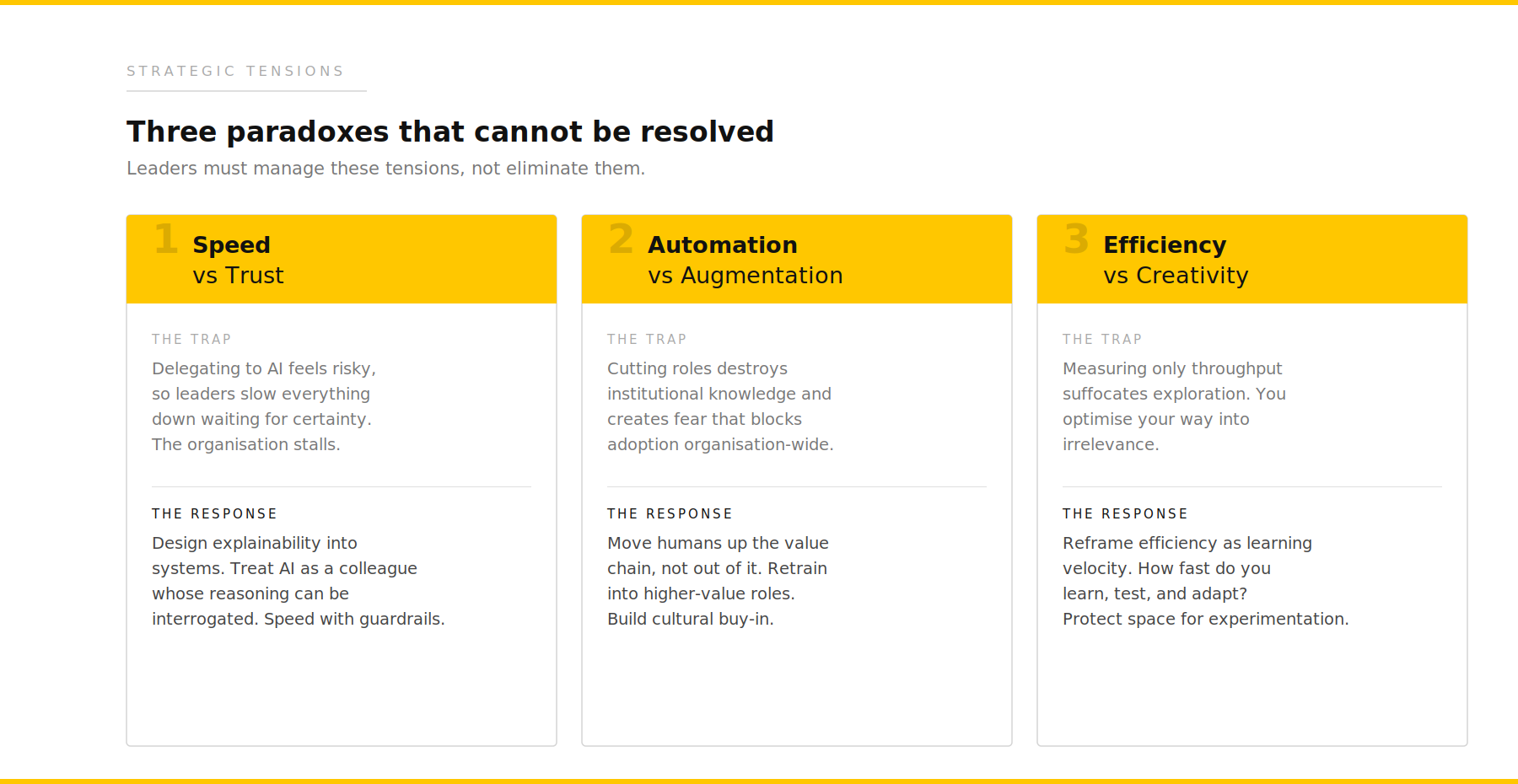
Three paradoxes leaders face
AI transformation surfaces tensions that cannot be resolved, only managed.
The role of the leader is changing
Leadership is no longer about controlling the system. It is about designing a system that can learn.
That requires a fundamental shift in how leaders think and operate.
This is not about removing structure.
It is about creating the conditions for better thinking, faster learning and more effective action.
What separates the best leaders
What will separate effective leaders from the rest is not their access to technology. It is their ability to recognise their own patterns.
In moments of pressure, most leaders fall back on what they know. Proven approaches. Familiar frameworks. Past experience.
It feels efficient. It feels safe.
But in a rapidly changing environment, it quietly limits what is possible.
The leaders who succeed are different. They recognise when they are defaulting to what they know, and deliberately shift toward what they need to learn next.
They ask: What are we missing? What has changed? What do we not understand yet?
And they extend this mindset beyond themselves. To their teams. To their operating model. To the organisation as a whole.
They do not just think about AI. They think with AI. They use it to challenge their own assumptions, expand their strategic thinking and explore scenarios they would not have considered alone.
They build organisations that prioritise learning over certainty.
How I think about this
I have spent over twenty years helping organisations navigate technology-driven change. As CEO of Alyve, I have guided strategy across government, healthcare, education, utilities, listed corporates, and financial services. I write about AI strategy for Forbes. I teach Digital and AI Transformation Leadership in the Deakin University Executive MBA. I am a Special Advisor on AI to YMCA Global and am consulting with leaders across sectors.
What I have learned, consistently, is that AI value is fundamentally a leadership and organisational change problem. Not a technology problem.
The organisations I see struggling are not struggling with the tools. They are struggling with how their leaders think about change, how their operating models absorb new capability, and how their cultures respond to ambiguity.
My work brings these things together:
Helping leaders see their own patterns. Where are you defaulting to control? Where are you narrowing possibility? Where are you avoiding ambiguity? We use AI not just as a tool, but as a thinking partner to explore scenarios, challenge assumptions and expand strategic thinking.
Redesigning how organisations operate. I co-developed the Intelligence-Centred Enterprise framework with a team of researchers and practitioners. It provides a practical model for shifting from rigid, control-based operating models to adaptive learning systems. It is grounded in the Sense, Reason, Act, Learn loop described above.
Building capability across the organisation. From board-level strategy sessions to team-level AI fluency workshops, I help organisations build the skills, confidence and permission structures they need to operate differently.
This is not about implementing technology.
It is about enabling a fundamentally different way of operating.
Most organisations are already feeling this shift. Few have a clear way to respond.
If your AI strategy is focused on efficiency, we should talk about what you are missing. If you are navigating this transition, or starting to question whether your current approach is enough, I would welcome the conversation.